Translate

Friday, December 29, 2017

Growing Through the Seasons of Life: Ecclesiastes 3:1-8; 14

Image result for growing through the seasons of life
 

Introduction

A new year is dawning. What will the new year bring? What will we leave behind in the 2017? What joys or sorrows await us in 2018? What will happen with those we love? What will happen in our world? What new adventures await us? What new challenges will confront us? Some look forward to the new year. Others wish time and change would slow down or perhaps stand still. One thing is certain - time moves ever onward and the season of life bring change.
 
As we look ahead it becomes apparent that there are many things in life we have no control over. We may love the summer but the seasons change and winter comes. The writer of Ecclesiastes in chapter 3 verses 1-8 writes perhaps the most powerful poem about time ever written. As we read it we are drawn into the rhythms of life. We can identify with the changes and seasons of life. As you study these verses think back over your life and how these verses describe your life. As you look forward take these principles into account. Always remember verse 1.
 

Some Background Information

The book of Ecclesiastes is one of the wisdom books of the Bible. Most scholars believe it was written by King Solomon. It consists of his observations of life. He was the richest mas of his time. He also was a highly educated man. He had spent his life in seeking what would satisfy and fulfill him. Despite his riches and power he did not find anything that truly satisfied him. He also realized that the seasons of life and time itself was outside of his control. He saw life as a rat race and an unending search for satisfaction. He saw that he did not have control over his birth or his death. At times in the book he concludes that the pursuit of things is meaningless. It is however in his search that he comes to realized that God is supreme and that the duty of man is to fear God. To fear God means to have reverence for God. To fear God is to surrender and humble oneself before God's power.
 
The book of Ecclesiastes is best understood from the point of view of God's sovereignty. God's sovereignty teaches us that it is God who is in control and not us. We learn that time itself is in God's control and he takes us through the seasons of life both good and bad. This understanding of God leads us to humble ourselves before God and surrender our lives to Him.
 

Devotional Ideas

1. Think about what season of life you are in now. What part of verse 1-8 do you most identify with.
 
2. Write out a prayer to God for the year 2018 asking His help through whatever transitions you anticipate as well as those you do not. Commit yourself to God for this coming year.
 

Final Thoughts

Now all has been heard. Here is the conclusion of the matter. Fear God and keep His commandments for this is the whole duty of man. Ecclesiastes 12:13 


Friday, December 15, 2017

Fear and Faith The Gift of God with Us: Isaiah 7:10-14

Image result for god with us

Introduction

Fear and faith are like oil and water. Two opposites that do not mix well. Fear and faith can each take us in a different direction. Our life is pulled by these two forces within us. Fear paralyzes us. Faith frees us to step forward. Faith is a gift of God. Fear is a strategy of Satan. Both faith and fear are contagious. Fear has a cousin named insecurity. Faith has a cousin named courage. God knows all about our fears and God is committed to building our faith so we will no longer be controlled by fear. These verses in Isaiah are all about faith and fear. The key to understanding these verses is to understand the context or the background of the verses.

Some Background Information

These verses are part of a message from God to a man named Ahaz who was the King of Judah (the southern part of the divided kingdom of Israel). Ahaz and the people he was leading were in a terrible situation and they were filled with fear. Isaiah chapter 7 beginning at verse one tells us the background. Two other kings and their armies had formed an alliance to attack and destroy Ahaz and the people of Judah. Verse 2 tells us that they were shaken as trees are shaken by strong winds - in other words they were terrified. God however had sent a message through the prophet Isaiah to Ahaz telling him that the attack would not succeed (verse 4-9). The challenge to Ahaz is to trust in God's word not in what he sees happening around him. Further background information can be found in the book of 2 Kings chapter 16.

King Ahaz had decide to take matters in his own hands and to not trust in God but rather make an alliance with the King of Assyria to help him. God offers to give King Ahaz a sign but he refuses a sign. He has decided to trust in chariots and horses and not in God and God's word. This proves to be a disastrous decision for the nation he was leading. God however gives a sign of His faithfulness in form of a prophecy or prediction. The prophecy is in verse 14. The prophecy is that a virgin young women would give birth to a child who would be Immanuel. Immanuel means God with us in Hebrew. This sign is intended to build our faith in the face of fear. The sign is designed to help us stand firm when circumstance would lead others to give up or run. This sign is design to be our rock through all the ups and downs of life.

The sign was fulfilled in the birth of Jesus. Matthew in chapter 1 verses 22-23 specifically indicates that the prophecy of a virgin birth predicted by Isaiah was fulfilled in Jesus birth. Luke 1: 29-37 tells the story of the virgin birth in detail. It is important to note that the incident of the virgin birth is followed by verse 37 of Luke 1 which states, "For nothing is impossible with God." A clear connection between the sign of the virgin birth and faith. The virgin birth make the point that nothing is impossible for God therefore we can place our full confidence and trust in him.

Devotional Ideas

1. A great book on faith and fear is, " What Are You Afraid of? Facing Down Your Fears with Faith" by David Jeremiah. This is a good book to read a few pages a day to build your faith.

2. Read and meditate this week on the virgin birth of Jesus (Luke 1:29-37) and what that means for you in your life.

Final Thoughts

If Jesus was born of a virgin and is God with us then will not Jesus meet all our needs and help us through all of our fears as we surrender our lives completely to Him?

Friday, December 8, 2017

The Gift of Restoration

Image result for the gift of restoration

Introduction

What is the theme of the Bible? What is the big picture? What is God doing in the world today? What is God's purpose in your life and my life? An excellent answer to all those questions is Restoration. Despite the secularization of Christmas the true essence of Christmas is restoration. As 2 Corinthians chapter 5 verse 19 reminds us "God was in Christ reconciling the world to himself." The prophet Isaiah in chapter 61 paints a beautiful picture of restoration. At the center of this picture of restoration Isaiah points to an individual who will bring restoration to broken people and to this broken word. Isaiah predicts this restoration in several other places most notably chapter 11 verse 1-9 and chapter 65 verses 17 - 25. In fact although the prophetic books of the Old Testament are known for their pronouncements of judgement equally evident is the pointing towards a future when there will be restoration of God's world and God's people. Think of how compelling a picture Isaiah paints of restoration. Think of how attractive and desirable this idea and reality is for people all around you.

Some Background Information

Isaiah point us to the future when an individual will come who will bring restoration to this world. In Luke chapter 4 verse 14-21 Jesus asks for the scroll (the bible was written on scrolls which were rolled up onto 2 wooden cylinders sort of like a shade) of the prophet Isaiah. Jesus unrolled it and found the portion we know as Isaiah chapter 61 and he read it. He then sat down (the position of a teacher in that culture) and Jesus announced that the scripture was fulfilled in Him. Jesus is the one who brings restoration.

The image of an oak tree in the Bible represents stability, strength, and permanence. Another scripture dealing with this image is Jeremiah 17:7-8. The picture of brokenness in Isaiah 61 verse 3 uses the images recognizable during the time of Jesus. People in mourning would put ashes on their heads and wear rough clothes made of sackcloth. People who were joyful would put on fragrant oil and dress with festive clothes. Verse 3 paints a picture of complete restoration. The images in verse 4 all deal with restoration and renewal. It is important to recognize that the renewal and restoration will be done by those who themselves have experienced renewal and restoration. This is a powerful image of the church of Jesus Christ. It is an image of restored people gathered together with the purpose of bringing restoration to a broken world.

Devotional Ideas

1. Read over these verse numerous times in the next week - challenge yourself to commit them to memory.
2. Seek to be an instrument of restoration in the life of someone in your circle this week.

Closing Thoughts

What greater purpose could there be for our lives than to be instruments of restoration? I have done many things in my life but nothing compares with seeing broken lives restored.

Friday, December 1, 2017

The Gift of Comfort: Isaiah 4:1-11

Image result for the gift of comfort 

Introduction

What an incredible beginning to Isaiah chapter 40. Comfort repeated twice. This is a word from God to His people in the midst of their failure and brokenness. The word comes to a people who have turned from God's ways and are now suffering the consequences. Previously in the book of Isaiah God's word has brought repeated warnings as God sought to bring his people back to Him. Yet His people persisted in their stubbornness and ignored God's call. Now that the consequences God sought to have them avoid have occurred it would be natural to think that God would turn away and say I warned you. Yet God sends a word of comfort. God is in a covenant relationship with His people and God will always be faithful to that covenant. There is always a word of comfort for mankind even in the darkest hours. There is a word of comfort for us even in the darkest seasons of our lives.

Some Background Information

Pay particular attention to the words and images used by Isaiah in these verses. The word comfort is a word that runs throughout the book of Isaiah - Isaiah 12:1; 61:2; 49:13; 51:3, 12; 52:9; 66:13. Isaiah connects comfort to the forgiveness of sins (verse 2). Think of a child who has been disciplined by a loving father who after the discipline brings comfort and dries the tears. Verse 10 and 11 paint a picture of God as a warrior and also as a shepherd (Psalm 23). The good shepherd of course gives His life for the sheep (John 10:11). Man is compared to grass and flowers that fade. This is a common image for man in scripture - James 1:10; Psalm 103:14. The image of going up to a Mountain to proclaim the Good news is powerful and speaks to our privileged responsibility to tell the Good news to all.

These verses in addition to painting compelling pictures of God's character and work also are a prophecy about the coming of the Messiah or savior and the forerunner who will announce His coming. Luke 3:1-6 points to John the Baptist as the fulfillment of this great prophecy. The verses can be easily divided into four movements. First verses 1-2 introduce the theme of comfort and restoration. Second verses 3-5 speak of the intervention of God to accomplish the salvation and restoration of His people. Third verses 6-8 point to the temporary nature of man and the inability of man to stop God's plan and purpose. Finally verses 9-11 issue a call to proclaim the message of comfort to the entire world.

Devotional Ideas

1. Look for others to tell the good news of comfort this week
2. Ask God in prayer to use you as a herald (messenger) of  His message of salvation 

Final Thoughts

Lets go tell it on the Mountain that Jesus Christ is born!


Friday, November 24, 2017

The Gift of the Father: Isaiah 63:16-64:8


Image result for god's gift

Introduction 

Amazingly the Bible repeatedly refers to God as a Father. No other religion has ever addressed its God with the title father. In the Old Testament God is referred to as father only a few times. In the New Testament Jesus makes clear that we are to pray to God as our Father (Matthew 6:9). The intimate and caring nature of God our father is developed in great detail in the New Testament in such parables as the prodigal son (Luke 15) and others. God's character is one of concern and care for the people He has created. The word Father reminds us of our relationship to God. This is an important understanding of God that is the key to our calling out to God for mercy in times of distress and brokenness.

Some Background Information

Isaiah was a prophet. A prophet is one who receives a message from God and speaks to God's people on behalf of God. These verses however are a prayer of Isaiah's to God. This particular prayer is categorized as a lament. A lament is a prayer of complaint to God during a time of brokenness and confusion. Isaiah has been called by God and has been doing what God asked him yet has seen people ignoring him, attacking him, and ridiculing him. In addition no one has been listening and living God's way. Instead it seems as if the people are getting worse all the time following after other God's and living immoral lives. Isaiah sees the bondage of sin that the people are in. Isaiah is frustrated and cries out to God.

After reciting what the problems are Isaiah asks God to intervene - to rip open heaven and come down and set things right. It is essentially a call for God to send judgment and make things right again. Isaiah is thinking about how God came down on Mount Sinai in power and fire (Exodus 19). God did respond to Isaiah's prayer in the fullness of time (Galatians 4:4). God did come down by sending His son God in the flesh Jesus the Christ. He did not come in fire (judgment) but rather in humility and service to offer himself as a sin offering so that God's wayward people could be saved. Jesus is in a real sense the Father's gift to all who turn to him in faith and that not of ourselves it (faith) is a gift of God. At the end of these verses Isaiah shifts his description of God from Father to a Potter (one who molds clay). What a wonderful image - a loving Father who will mold his children into what He created them to be.

Devotional Ideas

1. Write out a prayer of lament to God related to whatever situation you find yourself in - be honest with God.
2. In these 4 weeks before Christmas (Advent season) seek to give the gift of the Father - Jesus - to as many people as you can

Final Thoughts

What a wonderful reminder the Christmas season is that all of us are God's children and that he offers to us the gift of salvation and new life through His son Jesus. Receive that gift and give that gift.


Friday, November 10, 2017

The Money Trap

The Money Trap: Matthew 22:15-21 Image result for the money trap


Introduction 

We naturally seem to compartmentalize our lives. What I mean by that is that we think of our spiritual life as perhaps something we do on Sundays or 10 minutes in the morning before work to get us ready to face the day. We think of our work life as something disconnected from our spiritual life. We also see certain topics as spiritual such as prayer, reading the Bible and meditating and we see other topics such as money and possessions as something not at all connected to our spiritual life. The reality however is that we are integrated people. God created us to to have a spirituality that encompasses every aspect of our lives. Our view of money and how we use money are actually spiritual issues. Even a superficial reading of the Bible will reveal that the issue of money, finances and possession are a major topic in the Bible. Money and our view of money is critical to our spiritual health.

Money can be a source of great benefit to our lives or it can be a trap. Money and wealth are depicted in the Bible as a blessing from God (Genesis 13:2). Money is also associated in the Bible with sins such as covetousness (Exodus 20:17) and greed (1 Timothy 6:9). Both rich and poor follow Jesus. Think of the many issues related to money that we deal with today such as debt, poverty, a widening gap between poor and rich, corruption in government and dare I say it pastors flying around in private jets. Each person who is serious about following Jesus must come to an understanding or a theology of money that will guide their lives and decisions. Issues such as work, credit, savings, giving and other related issues are part of our every day lives as such our spirituality and our faith must address these issues.

Some Background Information

The Pharisees were seeking to trap Jesus so that they could accuse him and end His ministry. The Herodians were actually Jews who supported King Herod. The question they asked Jesus was intended to put Jesus in a no win situation. If Jesus said do not give tax money to Cesar then He would be accused of being a revolutionary and arrested. If Jesus said to give tax to Cesar then He would be accused of not being a real prophet and therefore be disgraced before the people and possibly arrested as a false prophet by the religious leaders. Jesus asked for a Denarius which was a Roman coin worth a days wages for a Roman soldier. The coin had the image of Cesar, the Roman ruler on it. Instead of answering the question Jesus transcended the question, that is, he took the issue to a deeper level - the heart level. Money and its role in our lives is always a heart issue. Is money our God? Does money have a larger importance in our life than it should? Is money our priority? Is our financial life in order? If not why not? What is the heart issue?

Jesus' answer in these verses is  the basis of a Spirituality of money. It has been called the 2 Kingdom approach. Give to Cesar (government - earthly things) what belongs to that sphere of life and give to God what belongs to Him. When put in those terms we see that the greater and harder to give is what is due God. God's love and grace towards us calls us to give Him our lives in surrender and service. Yes we should pay taxes, be honest in financial dealing, pay our debts, live simply content with what we have but above all we are called to surrender all we are and have to the Lordship of Jesus Christ. Once that surrender is made the other issues related to money fall into place and make sense.

 Devotional Ideas

1. Read and think about 1 Timothy 6: 6-10 and Philippians 3:7-11 and 4:10-13 this week.


Final Thoughts

What an honor and privileged to live life surrendered to God content with what He in His wisdom chooses to provide whether little or much

Saturday, October 21, 2017

Go Work Today: A Story of Two Sons

Go Work Today: Matthew 21:28-32


Image result for harvest timeIntroduction

Jesus loved to tell stories (parables). We all love to hear stories. When Jesus told stories he did so that we could find ourselves in the story. It was a great way to get behind our defenses and get us to look at ourselves. The story of the 2 sons is simple yet profound. When Jesus asked the question, "Who did the will of the Father?" everyone got the right answer. Jesus' point is are we DOING the will of God. The will of God is to bring in the harvest of souls before it is too late. The story has the elements of command: Go Work; the element of urgency: Today and the element of purpose: working in the harvest. The response of the 2 sons is interesting. The first says no but changes his mind and goes. The second says yes but never goes. How often do each of us know what God's will is but do not do it. Which son are you?

Some Background Information

The idea of the harvest is used throughout the Bible. An interesting study would be to read the different stories about the harvest found in the book of Matthew. It was an analogy that Jesus used often because he was speaking to people who were farmers and understood the importance of everyone working in the harvest. Tax collectors were considered traitors to their people. They were Jews who worked for the Roman government who was oppressing the Jewish people. They collected taxes from their own people on behalf of Rome. Many were corrupt and cheated their own people. For them to start following Jesus was causing the religious people to question Jesus and His authority. An incident of a tax collector named Zaccheus changing his life is found in Like 19:1-10. Note what he DOES. In the story of the 2 sons the Father represents God and the sons represent us. It is important to understand that Jesus chose the analogy of a relationship of love and care to describe our relationship with God. A father to his children. The final harvest of people's souls will come when Jesus returns - see Revelation 14:15. Repentance in the Bible always means to take action. In Luke chapter 3 verse 12 the people who are repenting ask John the Baptist what should we do? 

Devotional Ideas

1. Read the stories in Matthew about the harvest
2. Decide this week to begin looking for opportunities to reach lost people with the good news of Jesus Christ.

Final Thoughts

What a great honor and privileged and yes responsibility we have to be God's instruments in bringing in the harvest of people's souls.

Friday, October 6, 2017

Responding to Disaster

Responding to Disaster: Jesus Call to Us

Image result for puerto rico hurricane maria

Introduction

Are we living in the end times? Are all these Super storms, earthquakes, mass shootings signs that the end of our age is near? What is our response to disaster? Many people have different opinions on these questions. The one place to find the truth is in God's word - the Bible. Actually tragedy has been part of the human experience since Adam and Eve turned away from God. Each generation feels as if the tragedies it experiences are the worst. There are two scriptures which deal with the issue of tragedy both natural and man made. The first is Luke 13:1-5. Jesus spoke about a terroristic type of attack that actually killed people as they were worship God in the Jewish temple. Jesus also mentions a tower in Jerusalem that fell and crushed 18 people to death. Next in John chapter 9 verses 1-7 Jesus answers his disciples question when they wanted to know if a man had been born blind because either he or his parents were sinners.

God wants us to know why things happen and to know how to respond. Luke chapter 13:1-5 is actually part of a larger section of scripture. To understand the full context it is best to read chapter 12 and chapter 13:1-9. These verses along with the passage in John chapter 9 help us answer the questions posed at the beginning of this post.

Some Background Information

Luke 13:1-5 divides into two basic issues. First God's judgment and second our response of repentance. God's judgments are intended to wake us up and cause us to repent (turn) and start serving God. The fact that God will judge the nations is set forth in many scriptures. Some to look at are Isaiah chapters 13-24; Daniel chapter 2; Jeremiah 12:17 and of course Luke chapter 12. God's judgments are actually opportunities for us to turn back to God. The issue of repentance is the response Jesus says we should have in Luke 13:3 and 13:5. When we hear of hurricanes or other disasters we should remind ourselves that material things are temporary and that what matters in life is to be right with God. Our repose should not be to judge those who have been effected by the disaster but rather to judge ourselves and repent if that is needed.

John chapter 9 verses 1-7 gives us an understanding of how we are to respond to those who are suffering the effects of tragedy. Rather than wonder whether they sinned our response should be compassion and mercy. Some scriptures on God's call to us to be people of mercy are Micah 6:8, Matthew 5:7 and Luke 6:36.  In summary then our response to tragedy should be compassion directed towards those effected and examination of our own hearts followed by repentance if needed.

Some Questions to Use for Further Discussion in a Point of Light Group

1. What disasters or tragedies have you personally experienced?
2. What was the disciples attitude in John chapter 9 verse 2? What does that indicate about their hearts?
3. What was Jesus response to the man born blind? (John 9 verses 3-7)
4. What disasters did Jesus discuss in Luke 13:1-5?
5. What did Jesus mean in Luke 13 verses 2 and 4? Why do you think he said this?
6. Have you examined your life in response to all the recent disasters?
7. What do you need to change in your life to be right with God?

Final Thoughts

Let us be people who have hearts of compassion for anyone effected by a disaster and let us continually examine our hearts and live a life of repentance.

Friday, September 22, 2017

Building a Strong Church Together

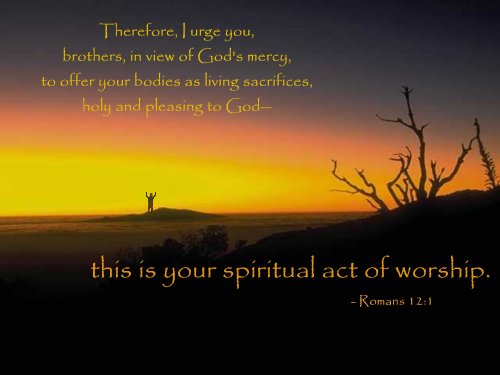
Building a Strong Church Together: Romans 12:1-8


 Image result for romans 12:1

 Introduction

 When we think of spirituality we think of such things as reading the Bible, meditation, attendance at a service, fasting, prayer or some other form of religious practice. The Apostle Paul however radically challenges our ideas about what is a spiritual act of worship. God's definition of spiritual worship is self sacrifice lived out in our daily interactions with others in both little and big ways. In fact if you were to read Isaiah chapter one you would see that God hates religious practices that are not part of a daily life lived in service to other. As Paul indicates in verses two and following to live this way requires living against the current. Self sacrifice is never our default setting. Self is our default setting. Our minds have been conformed to the pattern of the world which is self first. What is required is a transformation of our minds so that we will have the mind of Christ. Jesus sacrificed himself so that others could be forgiven. Jesus is the example.To live this way is truly counter cultural. Yet to live this way is to actually find ourselves and to step into the life for which God created us (Matthew 16:25).

Some Background Information

There are three parts to these verses. The first (verses 1-2) deal with the issue of finding your life by losing your life in service of Jesus. The second deals with the issue boasting and how we see ourselves (verses 3-5). The third part deals with being a part of Jesus body with others working together cooperatively and with all our different gifts making one powerful team (verses 6-8). While each part could be a separate topic it is important to see how each topic builds on the other. For example without an attitude of self sacrifice working together is not possible. The key I believe is to know yourself and to know the part God wants you to play. The images Paul uses are clear. First he uses the image of a sacrifice. The Jews at that time were familiar with animal sacrifices which were placed on the altar and burned up as a total offering to God. The image is of us placing ourselves on the altar and sacrificing ourselves for God's purposes. The second image is easier for us to understand. It is the image of a body with many parts. Each part has a role to play. As the parts work in harmony together the body can do amazing things together. We all have had the experience of suffering because one part of the body no longer is doing its job (broken leg etc). It is this image of a body that Paul uses to describe a church both here and also in 1 Corinthians chapter 12. Paul lists some gifts in these verses in Romans as examples. There are other gifts listed in other places in the Bible.

Devotional Ideas

1. Pray over veres one and two and ask God to show you ways you are conformed to the world in your attitude.
2. This week seek to serve people around you.
3. If you do not know your spiritual gifts take the step to learn them. You can leave a message on this blog and I will direct you how to do that.

Final Thought

Find your place in God's Kingdom and lets get to work together. When all is said and done that is what really matters. 

Saturday, September 2, 2017

Building Strong Children Together: Ephesians 6:1-4

Building Strong Children Together: Ephesians 6:1-4

Image result for ephesians 6:4

Introduction

The book of Ephesians is a book of theology (meaning a study of God and what He is like). In the book of Ephesians we learn about God's character and His purpose in the world. We discover our place in God's plan and how we can enter into the life God created us for. Yet right along side these lofty ideas is clear direction on how to raise children. Theology is intimately connected with how we treat each other and especially how we treat the weakest and most dependent among us. If we truly know God we will treat others with love. The Bible assumes that children have great value and are an equal part of the family of God. Paul reminds parents of their authority and responsibility to raise their children to know and love God. One writer stated, that "we live in a world where parental power can be abused even including sexual abuse of children and on the other hand attempts to exercise moral discipline or correction of a child can frequently be denounced in the name of a child's freedom or autonomy. How wonderful it is that God provides us guidance in His word.

Some Background Information

At the time these verses were written they were radical. In Roman society the father of a family had absolute power over his children. He could have them beaten and even killed if he so decided. He could sell them into slavery to raise money. Weak or deformed children were often left out in fields to die. In that context God makes clear that parents have a God given responsibility to raise and nurture and train their children. These verses are no less radical in our times as courts and governments redefine marriage and the family unit. These verses quote from one of the ten commandments found in Exodus chapter 20 verse 12 and Deuteronomy chapter 5 verse 16.

Devotional Ideas

1. If you have children in your home start a weekly family devotional time. Read a Bible portion, discuss it and then talk about what each one needs prayer for and have each memeber of the family pray for one another.
2. If you do not have children at your home pray and look for one child who you can impact in small ways. Perhaps a child at church or in your neighborhood. Look for ways to encourage that child and pray for them daily.

Final Thoughts

True change in our society will only come about as we begin to do what we can to build strong children together. Lets do our best.

Saturday, July 29, 2017

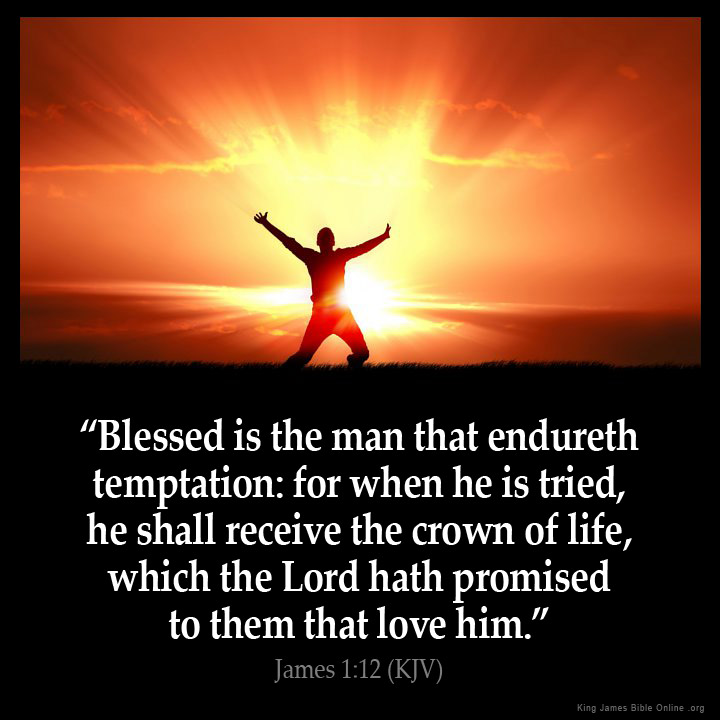
The Overcomers Blessing: James 1:12-18

Image result for james 1:12 

Introduction

The book of James is a very practical book. It was written by the brother of Jesus who was very concerned how people lived in their day to day life. He like Jesus grew up in a culture filled with religious people. Often however there was no connection between people's religion and everyday life. Naturally everyone agrees that it is good to resist temptation. Yet when you are in the midst of the temptation it is not easy to resist the temptation. What practical advice could James give to those who faced the temptation to turn away from God due to persecution? James focuses them and us on the prize that is ahead of us. The student who wants to quit when the studying becomes hard and boring thinks of the goal of graduation and endures. I am sure you can think of many examples of this basic life principle. In 1 Corinthians chapter 9 verse 25 Paul writes about athletes going into training to obtain the crown (the Greeks gave the winner of a race a crown, sort of like we give athletes a gold medal today). Paul states that we also will receive a crown and should therefore be like athletes and focus on the goal. Hebrews chapter 11 is filled with examples of people who endured terrible trials and temptations yet they endured and obtained the crown.

Some Background Information

The word that is translated as trials in verse 2 and 12 is the same exact word that is translated temptation in verses 13-14. From this we can see that these verses are a continuation of the first section dealing with trials. In verses 14-15 James gives a great description of how sin is born and how sin leads to death. Understanding how this works helps us in a practical way to break the cycle of temptation - sin - death. A vivid example of how temptation works is also found in Proverbs chapter 7 verses 6-23. Asking God for help is a key component of breaking out of the sin cycle and becoming an overcomer. James description of God's willingness to help is a great encouragement to all of us who face temptation.

Devotional Ideas

1. Identify a patterns of sin in your life and specifically ask God for help in those areas. He will help.

2. Explain to someone verses 13-15

Final Thoughts

The crown of life will be glorious. It will make everything we have suffered more than worthwhile. Let us keep our focus on that crown and never give up!

Saturday, July 22, 2017

James 1:1-11: The Purpose of Testing

Image result for James 1:2
 

Introduction

Joy and trials do not seem to go together. In fact much of what the Bible has to say makes no sense to us. The reason for this is that God looks at things from an entirely different perspective or point of view than we do. We focus on the present God focuses on the eternal. We focus on our comfort God focuses on our character. Once we begin to align our way of thinking with God's way of thinking then God's word make perfect sense. In these verses James sets forth the reason why trials of many kinds are actually a benefit to us. The basic rational is as follows: Trials develop patience and patience builds mature character leading to stability in life and faith. Similar ideas are found in Romans 5:2-5 and 1 Peter 1:6-7. It is clear throughout the Bible that God is always at work building and refining the character of those who follow him. One could pick any Bible character and see this dynamic at work. The goal therefore is to have the mind of Christ. Once we do we will count it joy when we face trials of many kinds.
 

Some Background Information

James was the brother of Jesus who initially did not believe that his older brother was the savior. Yet after the crucifixion and resurrection of Jesus James became a believer and then became the most influential leader in the early church. How James came to believe is not recorded in scripture perhaps it happened when Jesus appeared to him after the resurrection (1 Corinthians 15:7-8). James stayed in Jerusalem and was the leader of the church there. This book is written to all of the Christians who had been scattered all over the world. Suffering and trials are one of the main themes of the entire book of James. He returns to this topic several times throughout the book. James also under the influence of the Holy Spirit believed it was a topic all of the new believers needed to understand. Wisdom is also a second prominent theme in the book of James. It is easy to see the connection between suffering, trials and wisdom. 
 

Devotional Ideas

1. Study the life of Joseph in Genesis chapters 37-46. Note how God uses suffering in his life and Joseph's response each time. 
 
2. Memorize James 1:2-4
 

Final Thoughts

The goal of life is not to avoid trials but to allow them to mold us into the mature people God intends us to be. May you be blessed and experience joy as you surrender to God's working in your life.   

Saturday, July 15, 2017

Be Compelled by Love: 2 Corinthians 5:14-20


 Image result for Christ's love compels us


Introduction

The book of 2 Corinthians was written by the Apostle Paul to a church in the Greek city of Corinth. There are ruins of the city of Corinth that you can visit today. The church was filled with very spiritually gifted people. Unfortunately they had drifted away from the purpose God had for their lives. Instead of focusing on building God's kingdom and spreading the message of Jesus they were distracted by arguments between each other and by sinful behavior. Paul writes the two letters to the Corinthians to help them resolve the issues that are distracting them and to refocus them on reaching others. These verses above are very well known particularly verse 17 of chapter 5. Followers of Jesus love to remember how Jesus changed them from what they used to be into a new creation. It is however easy to forget that what God did in us he wants to do in those around us.

Paul discusses his motivation for devoting his life to spreading the message of new life in Jesus. Paul's only motivation was the love of Christ. Love is the most powerful of all motivators. Love leads to sacrifice of ourselves for the good of others. John 15:13 tells us that there is no greater love than someone laying down their life for others. The Bible is full of examples of people whose lives were changed by Jesus and this experience of God's love compelled them to devote their lives to letting others know the same love of Jesus. Some examples are the Apostle Paul (Acts 9); the woman at the well (John 4) and the Gaderene demoniac (Mark 5). Truly understanding God's love for us will compel us to reach others.

Some Background Information

The word that is translated compels in verse 14 can literally be translated as a pressure which confines, restricts and controls. The image is of a force of energy from within that motivates us. Truly having God's love in our hearts will compel us to do everything we can to share that love with those around us. A key concept in the Bible is the concept of stewardship. A steward is someone who has been given something and who will be held accountable for what they do with what they have been given. Followers of Jesus have been given the message of reconciliation and the ministry of reconciliation (connecting people to God). We who are followers of Jesus have been entrusted with the responsibility of telling others the good news of salvation through Jesus. We have been entrusted with the task of building God's kingdom. We act on behalf of Jesus as His representatives. Paul calls us ambassadors.

Some Devotional Ideas

1. Go over your friends list or if you have not made one write down the names of 5 people you know who do not know Jesus. Begin to pray for them daily. Develop a strategy for telling them the message. Make connecting people to Jesus a priority in your life. 

2. Meditate on God's love for you. Use Romans chapter 8: 38-39

Final Prayer

Lord Jesus fill me with your love and let it overflow to others - Amen.

Thursday, July 6, 2017

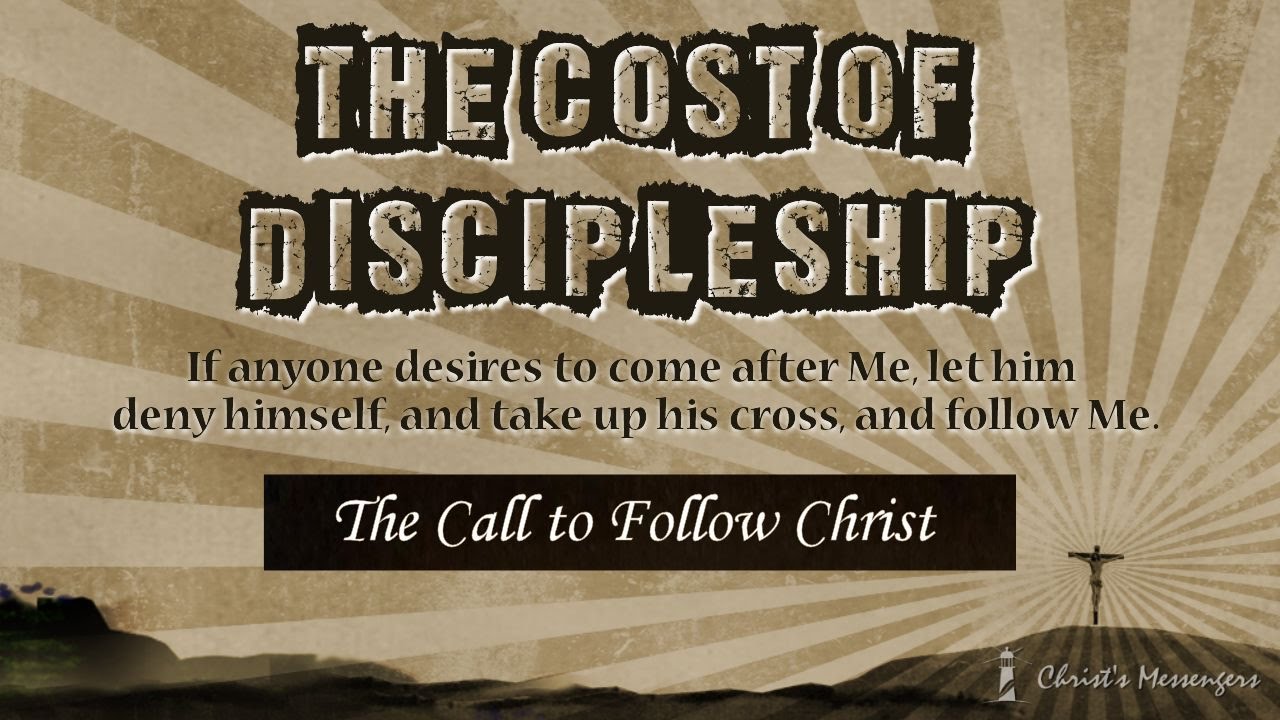
The Cost of Discipleship: Luke 9:18-27

 Image result for the cost of discipleship

Introduction

These verses are some of the most powerful verses in the Bible. It is here we discover the very essence of what it means to be a follower of Jesus. It is here we learn who Jesus is and what His mission was. One could almost say that these verses alone are enough to explain all we need to know. It starts with Jesus revealing himself as the Christ. The Christ means the anointed one of God. It would have been understood by people of that time as a claim to be equal to God or to put it another way to claim to be God in the flesh. Then in the very next breath Jesus explains that he is going to voluntarily sacrifice his life so others could be saved. That is the cross of Jesus. That cross is the source of forgiveness, new life, transformation and spiritual power. Jesus next applies that same line of thought to those who would be his followers. Our cross is not the ordinary human troubles like sickness, disappointments, poverty and the things most people usually associate with their cross. Rather our cross is what the follower of Jesus sacrifices, gives up, endures in order to serve Jesus and His mission. It includes persecution and opposition. 

Some Quotes to think About

Every person is confronted with the choice of either denying themselves together with their reputation, desires, and comfort or of living for themselves and the world and so denying Christ.
                                                                               Norval Geldenhuys

He is no fool who gives what he can not keep to gain what he can not lose. - Jim Elliott

When Christ calls a person he calls him to come and die  - Dietrich Bonhoeffer

Some Devotional Ideas

1. Read the verses 23-27 slowly word by word. As you do think of each word and let it sink deep in your spirit.

2. There is a great book by the name, "The Cost of Discipleship" by Dietrich Bonhoeffer  perhaps you would want to get it and read it a few pages at a time this summer.

Saturday, July 1, 2017

Walking with Jesus to the Cross: Mark 10:32-45

Image result for mark 10:33-34 

Introduction

As we read these verses the contrast between Jesus and the disciples is incredible. The follower's mentality and focus is entirely different than Jesus'. The way the followers view themselves and life is as different as night and day from the way Jesus views the same things. Jesus is focused on self sacrifice and going to the cross. The followers are focused on self advancement going to a throne. The key to spiritual growth and spiritual power is becoming transformed from the way we are to the way Jesus is. It is in these key areas of our lives where we see differences between how Jesus thinks and acts and how we think and act that God will work in our lives. Robert Mulholland writes as follows:

    Our cross is the point of our unlikeness to the image of Christ, where we must die to self in order to be 
    raised by God into wholeness of life in the image of Christ right there at that point. (Invitation to a
    Journey).

 As you read these verses note the difference between Jesus and his followers in their outlook. Jesus willingly and purposely gave his life for others. The followers seek to avoid the cross and live for themselves.

Some Background Information

Jerusalem was the religious and military capital of the region. This is were those who opposed Jesus and had threatened Him were located. This was were the headquarters of the Roman government for that region were. To march right into Jerusalem was to walk into danger and certain death. It was the road to the Cross. The disciples had argued among themselves many times as to who was the greatest or most important follower of Jesus (Luke 22:24 is one example). Each time this would happen Jesus would explain to them the basic spiritual principle of His kingdom - greatness is defined by self sacrificial service. Jesus demonstrated this principle in everyday life. In John chapter 13 verses 1-20 Jesus washes His disciples feet after they would not do so to each other. Jesus' death on the cross is the ultimate example of self sacrifice for others.  Paul reminds us in Ephesians 5:2 to walk in self sacrificial love each day in little and big ways.

Some Devotional Ideas

1. Where do you see God working in your life? What points of difference between you and Jesus in your attitudes and actions is he bringing to the surface? Reflect on this and pray to be conformed to the image of Jesus. Walk to the cross with Jesus.

2. Look for opportunities to serve others this week - walk in the love.

Final Thoughts

Let us walk with Jesus to the Cross. It is there we will find everything we have been seeking on other roads.

Saturday, June 24, 2017

The Power of the Cross: 1 Corinthians 1:18-25

Image result for the power of the cross 

Introduction

The Power of the Cross. The Greek word for power is dunamis from which we get our word dynamite. The Dynamite of God sounds like what we need! The cross in Bible times was a place of death. It was an instrument of torture. Yet Paul insists that the message of the cross is the power of God. The power to forgive, the power to save, the power to transform, and the power restore. Yet throughout history man attempts to turn the message of the Cross into something it is not. People say Jesus was a good teacher and that we should imitate Him and put his teachings into practice. Jesus did teach but He came to die on a cross. Without the cross there is no power. What we need is power. Following Jesus' teachings without applying the message of the Cross is powerless. Paul in Romans 1:16 declares that he is not ashamed of the gospel because it is the power of God. The gospel is summed up simply in 1 Corinthians 15:3-4. Jesus died on the cross to forgive our sin. To forgive the guilt of sins committed and to transform our sin nature into a Christlike nature capable of following Jesus in everything. We need the cross applied to our lives daily. People who pass us by each and every day need the cross applied to their lives. There is no greater call than to tell the message of the cross for in the message of the cross we will find the power of God.

Some Background Information

The church at Corinth was in present day Greece. Paul spent considerable time in Corinth and developed a strong church there (read Acts chapter 18 for Paul's time there). Paul wrote two of his longest letters to the disciples at Corinth. The first letter (1 Corinthians) was written to correct certain wrong practices that had developed. There were divisions in the church, sexual immorality, a wrong understanding of spiritual gifts among other issues. Apparently the church was also being influenced by Greek ideas of wisdom and philosophy. Paul clearly brings them back to the message of the cross. The message of the cross does not need to be added to with any type of wisdom or deeper knowledge. The message of the cross which is mystery in itself is all that is needed. This is an excellent book for today in which the ideas of Humanism are very strong. Self sufficiency is the philosophy of our time and this was the philosophy the Corinthian church was starting to follow. 1 Corinthians is a book for our time.

Devotional Ideas

1. Read through the entire book of 1 Corinthians this week to get an idea of what Paul's concerns were. Imagine yourself receiving this letter and reading it for the first time.

2. As an exercise in self examination. Read 1 Corinthians chapter 13 verses 4-8 and substitute your name for the word love as you read it.

Final Thought

The message of the cross: Know it; Apply it; Tell it.


Saturday, June 17, 2017

Psalm 1: Chose the Path of Blessing

 Image result for psalm 1

Introduction

The imagery in Psalm one is both beautiful and profound. The image of a tree planted by streams of water bring to mind and heart feeling of peace, contentment, provision and health among others. The image of chaff brings to mind and heart feelings of dryness, brokenness, uselessness and lack. These two images are opposites in every way. The tree produces fruit. The chaff does not. The tree endures and lasts through the windy stormy times. The chaff get blown away. The tree prospers. The chaff does not. The writer of this Psalm is a master of using a few words to create images in our minds that convey a thousand words and ideas. The tree represents one kind of person and the chaff another kind of person. We are drawn into the Psalm as we seek to find out what make the difference between the two. We wonder which of the two are we?  As we read further and absorb the teaching of this Psalm we learn that what differentiates the two types of people is God's word. The people represented by the tree are those who read, obey and apply God's word to their lives. The chaff are those who do not obey and apply Gods word to their lives. The Psalm has a happy and a sad ending. A sad ending for people who do not obey and apply God's word. These people will not stand on the day of judgment. They will be blown away. Those who obey and apply God's word will be 'watched over' by the Lord. This is  a phrase used in the Bible to indicate care, love and protection. 

Some Background Information

Psalm one is known as a wisdom Psalm. It is a Psalm designed to teach us how to live our lives. It is similar to the book of Proverbs (see Proverbs 2:12). A familiar concept in Proverbs as in Psalm 1 is that there are only 2 paths or ways that one can chose from in life. The first way is a life of blessing which is the path of obedience and fellowship with God. This is the path of the wise. The second path is the path of a fool. This path is the path that leads to brokenness and ultimate destruction. It is the path of disobedience to God's word. A very similar image of a tree is found in Jeremiah chapter 17 verses 5-8. Chaff is the outer cover of grain. It is the husks and fragments like straw that are of no substance and are just blown away by the wind leaving behind the grain. The word 'therefore' in verse 5 points to the conclusion of each person's life. There is a day of judgment. On that day our true substance will be revealed. That is the day when the consequences of walking on the wrong path will be felt.

Devotional Ideas

A key word in this Psalm is meditate. An excellent devotional practice is to meditate on God's word. You do not have to sit on the floor with you legs crossed. Rather read a portion of God's word several times. As you read notice different things that God brings to your attention. Think deeply about what you have read. Ask yourself questions like; 'How does this apply to me? How can I apply this in my life? Throughout your day bring the scripture back to your mind and think about it as you go through your day. Perhaps you could meditate on Psalm One this week. Remember what is important is the deepth of your thought not the number of verses you read.

Final Thoughts

How wonderful to be a tree planted by streams of cool fresh water in the midst of a dry and weary land. May that tree represent your life.

Friday, June 9, 2017

Psalm 137: Breaking the Cycle of Anger 

 Image result for anger and revenge

Introduction

We see it every time we read or watch the news. Revenge. The Middle East has been locked in a perpetual cycle of violence because of revenge. We see it in a personal scale in our own communities when someone is attacked or killed in response to a prior attack. We feel it in our hearts when someone hurts us deeply. We see within ourselves a desire to lash out and extract revenge upon a person who hurt us. This happens in marriages, in business and everywhere that people interact. Revenge of course is nothing new. It is the story of mankind. Psalm 137 drips with pain and cries out for vengeance. Unlike many other Psalms this Psalm does not come to a resolution. There is no 'therefore I will wait upon the Lord' or 'trust in the Lord and do good'. Instead just raw emotion hurled at God in a prayer. What sense can we make of verses 8 and 9? Are God's people capable of such depth of anger and vengeance that they would wish to see their enemies babies smashed upon rocks? The sad answer is yes. As Jeremiah reminds us the human heart is desperately wicked (Jeremiah 17:9). The Bible however does not stop at Psalm 137. The human race cries out for a balm to heal the depravity within each of us. God's plan all along is to provide just what is needed to change our hearts from desperately wicked to pure love. Jesus and his death on the cross is the balm that each of us need to break the anger cycle.

Some Background Information

This Psalm was written during the captivity (the period in Israel's history when they were taken captive to Babylon). It is written by a people who have lost everything and experienced the consequences of their turning away from God. Psalm 137 is known as an imprecatory Psalm. That is to say it is a call to God to bring judgment upon ones enemies. Other Psalms of this type are Psalms 69 and 109. Babylon had invaded Judah and Jerusalem and destroyed it and taken many of the people captive. Edom was a neighbor of Judah. The people of Edom were the decedents of Esau and thus in a distant sense cousins of the Jews since both were descended from Issac. When Judah was attacked by Babylon the Edomites cheered and looted their neighbors. The book of Obadiah verse 10-14 gives background on what happened. Psalm 137 like every portion of scripture must be read and understood in the context of the entire Bible. Certainly the teaching of Jesus calls for a different response to our enemies than we see here in Psalm 137. The death of Jesus on the cross if received into our lives gives us the power to respond differently when others do hurt us.

Some Devotional Ideas

1. Let God know your true feelings in prayer. This Psalm is an example of that.
2. Examine your heart regularly and resolve hurt and anger promptly and appropriately.
3. Take time to pray for your enemies and do good to those who are against you. (Romans 12:19-21

Final Thoughts

Let us never deceive ourselves and think that we are not capable of the worst possible thoughts and actions. In view of that may we rely on Jesus and His power daily to live as He did in pure love not hatred.

Saturday, June 3, 2017

Rest in God's Secret Place: Psalm 31

 Image result for stress scale

 Introduction

We are daily faced with stress both major and minor. From the stress of a traffic jam to the loss of a job. From the stress of a flat tire to the death of a loved one. The question is not whether you will have stress in your life but how much and how it is effecting you. Stress is cumulative. It adds up until the proverbial straw that breaks the camels back. There is a famous chart assigning point to various life situations that cause stress. Here is a copy of one such chart:
Image result for stress scale
Once you reach 300 points you are at serious risk for a mental or physical or emotional breakdown. What is your stress number?  Psalm 31 arises out of an extremely stressful time in King David's life. The specific situation is not mentioned but by carefully reading the text we can see what he is feeling and experiencing. Read through the text and see what number David would have on the above scale. My guess after adding up the numbers is that David was at about 424. In other words overwhelmed. Where would you place yourself on this scale?

Some Background Information

David knew where to go when faced with overwhelming situations far beyond his ability to cope. David ran to God. David knew that God has a secret place, a refuge, in the midst of the stress where he would find peace. Notice the words David uses to describe God. Words like refuge, rock, strong fortress and dwelling. These words convey a mental picture of an impenetrable fortress where one can take refuge from the stresses of life. Verses 14-18 contain a beautiful prayer of faith in God in the midst of overwhelming stress. A key word in this Psalm is the word TRUST! I love verse 14 which begins his prayer with "But I trust in you O Lord." As if to say yes all this is happening and yes it looks overwhelming But I chose to trust in the Lord. David enters God's secret place through the door of trust. Once inside God's refuge David leaves all of the stressful situations to God and he finds the peace that passes all understanding guarding his heart and mind. (Philippians 4:6-7).

Some Devotional Ideas

1. Look up and read other scriptures that speak of God's peace.
2. Read Psalm 91
3. Pray Psalm 31:14-18 for your self.
4. Monitor your stress level and make the changes that are within your power.

Final Thoughts

How wonderful to live in God's secret place. Make that your goal this week. It is my goal.

Saturday, May 27, 2017

Psalm 42: Healing for Life's Losses

 Image result for psalm 42

 Introduction

Psalm 42 is an excellent example of what a Psalm is. A Psalm is written in poetic language and is usually meant to be sung as a song. There is something about singing that helps us to connect with our emotions and pour our heart out to God. In fact some of the words of this Psalm form the basis of a well know Christian song entitled "As the Deer." Here is a link to that song. https://www.youtube.com/watch?v=UZv3jzOTE70
Many times I have sat down at the piano and poured out my heart to God while singing this Psalm.

Most scholars believe the Psalm was written by King David. It seems to fit a time in his life when he was exiled from and running for his life (perhaps the time when either Saul or Absalom had forced him to run from Jerusalem). He was in depression at the loss of the opportunity to worship in the temple and being far away from the people he loved. Note that the Psalm or song is written to the chief musician. Probably he was in charge of the worship at the temple. God put this and other Psalms of loss in the Bible because loss is something we all will face in our lives. It is wonderful to be able to turn to the Psalms to help us give words to our emotions. Note also how David uses examples such as the deer seeking water that vividly describe his deepest feelings. The Psalms are given to us to help us express what sometimes is hard for us to express to God. It also is comforting to know that great people of God have gone through the same struggles that we face and rather than turning away from God they actually drew closer to God.

Some Background Information

Psalm 42 and 43 go together. In fact many believe that at one time it was one Psalm. Note the repeated verse in Psalm 42:5 and 11 and Psalm 43:5. Psalm 42 express the inner working of David's thoughts and emotions. He is struggling with his emotions while at the same time reminding himself of God's truth. We are emotional people yet we are also people of faith and at times it is a struggle to reconcile how we feel with God's truth. Yet it is God's truth that comforts David and directs him. This Psalm unlike other Psalms does not come to a resolution. Rather it is a snapshot of the inner working of David's emotions. Depression and grief require a process before there is reorientation and healing. David gives an excellent description of all the feelings that accompany loss: tears; questions; remembering; noone understanding; emptiness; inner struggles.

The key word in Psalm 42 is found in verse 5 and 11. That word is Hope. It is hope in God and the knowledge that He is with us and will restore us that enables us to go through times of loss and grief. Hope is an anchor of our soul (see Hebrews 6:18-19). Without hope depression and loss will destroy us.

Devotional Ideas

1. Use this Psalm as a prayer guide add parts that are specific to your situation.
2. Write down your own Psalm of grief using this Psalm as a model.
3. Pour out your heart to God using the song As the Deer.

Final Thoughts

What a great example God has given us in Psalm 42. How wonderful it is that when we go through difficult times of loss we can pour out our hearts to Him. How valuable to know that no matter how devastated we are in Him there is Hope and recovery. Let us remind ourselves of these wonderful truths as we walk through the difficult seasons of life. May the Lord give you a heart like David's.